Psychology
Know whether your confidence is earned
Every journal shows an equity curve. Traquil lines up how sure you felt, how focused you were and what you were feeling with what each trade actually did, and only speaks once there is enough data to say something true.
Free plan, plus 14 days of Pro with no card.
On the Free plan.
What it does
The calibration curve
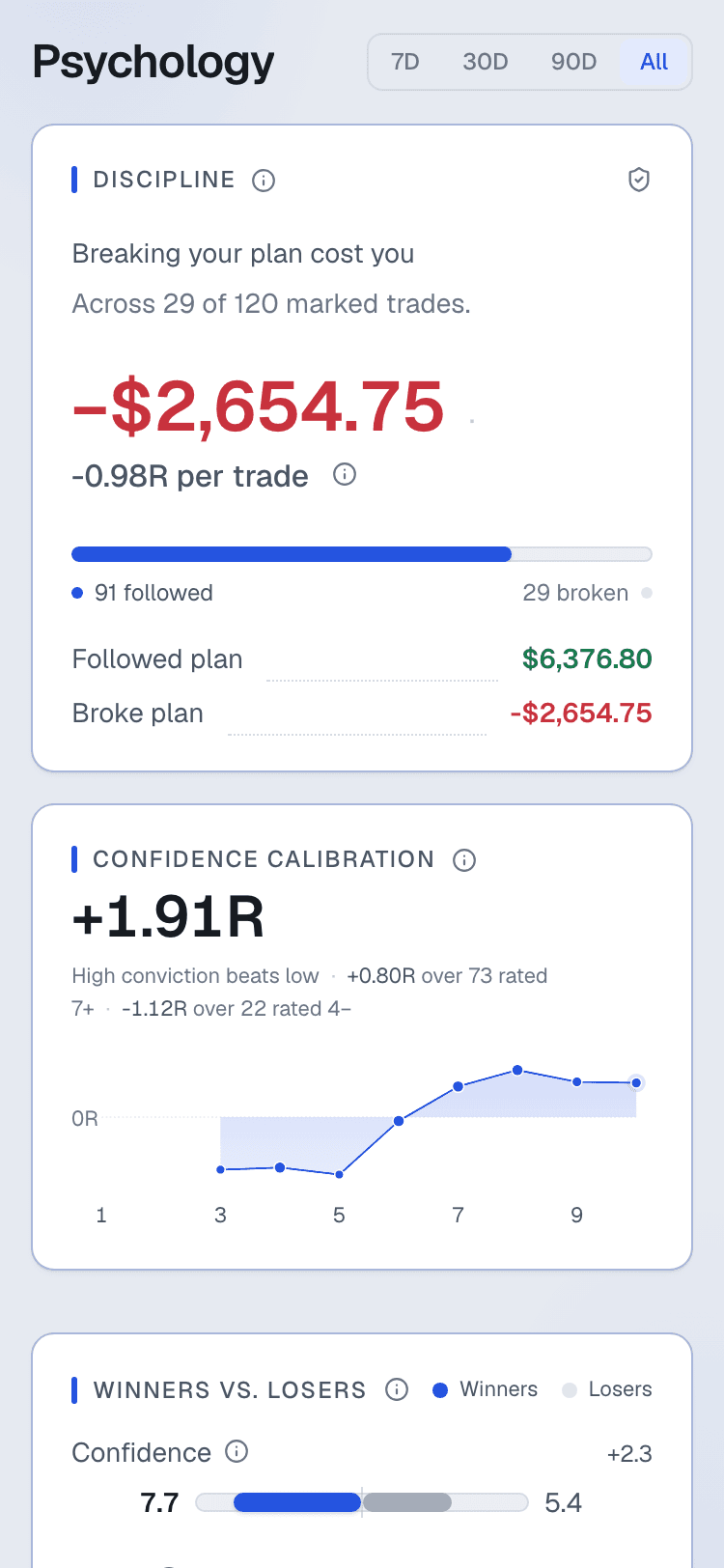
Your confidence rating on each trade plotted against how those trades turned out. If your 9-out-of-10 trades win no more often than your 5s, the curve shows it, and that is worth more than any amount of reassurance.
Emotions against results
Calm, anxious, revenge, FOMO and the rest, each lined up with the results of the trades it came before. Not a mood diary: a ledger of what each state of mind has cost or made you.
What breaking your plan cost
Trades where you followed your plan against trades where you did not, side by side, so discipline stops being an abstract virtue and becomes a number in your own history.
Winners against losers
Confidence, focus and hold time on your winning trades compared with your losing ones. Patterns like holding losers twice as long as winners show up here first.
Evidence-gated, never guessing
Every read on the page waits until there are enough tagged trades behind it, and a coverage meter shows how much of your history is tagged. It would rather say nothing than say something it cannot back up.
The Quil Score
One number from 0 to 100 on your dashboard for how much evidence there is that your edge is real, graded from your own trades. Sample size counts as its own part, so twenty lucky trades do not read as a proven edge. It measures your trading, never predicts it.
What it will not do
Said plainly, because a journal that overstates itself is the wrong tool for seeing clearly.
- It can only read what you tag. A quick tag on every trade is what makes the page useful.
- It never tells you what to trade, and it never scolds. It is a mirror, not a coach.
Questions
What is the Quil Score?
A 0 to 100 grade on your dashboard for how much evidence your own trades give that your edge is real. It looks at expectancy, payoff, stability, risk control and sample size, and every part has an info button that says exactly how it is graded. It describes your history; it does not forecast results.
What is a calibration curve?
A chart of how often your trades won at each confidence level you gave them. A well-calibrated trader's high-confidence trades win more often than their low-confidence ones. If the line is flat, your confidence is not telling you anything yet.
How many trades before the Psychology page is useful?
Each read appears once there is enough tagged data behind it, and the page says when it is waiting. The more trades you tag with confidence, focus and emotion, the sooner it speaks.
Keep exploring
- Revenge tradingHow to spot it in your own data, and what to do with that.
- A trading psychology journalWhy a mood diary is not enough.
- Mistakes TrackerYour biggest leak, what each mistake costs, and whether it is getting rarer.
- Trading journalFast logging, screenshot autofill, Session Prep, the news calendar and your reviews.
- Ask Quil and AI reportsPlain-language answers about your own trades, and weekly and monthly reports.
See your own trading clearly
Open the demo to see every page on sample data, or start your own journal. The Free plan is yours to keep.
Free plan, plus 14 days of Pro with no card.